
Half of shipping now uses electronic bills of lading. What changes for a small forwarder?
By CargoGen Team · 2 November 2026
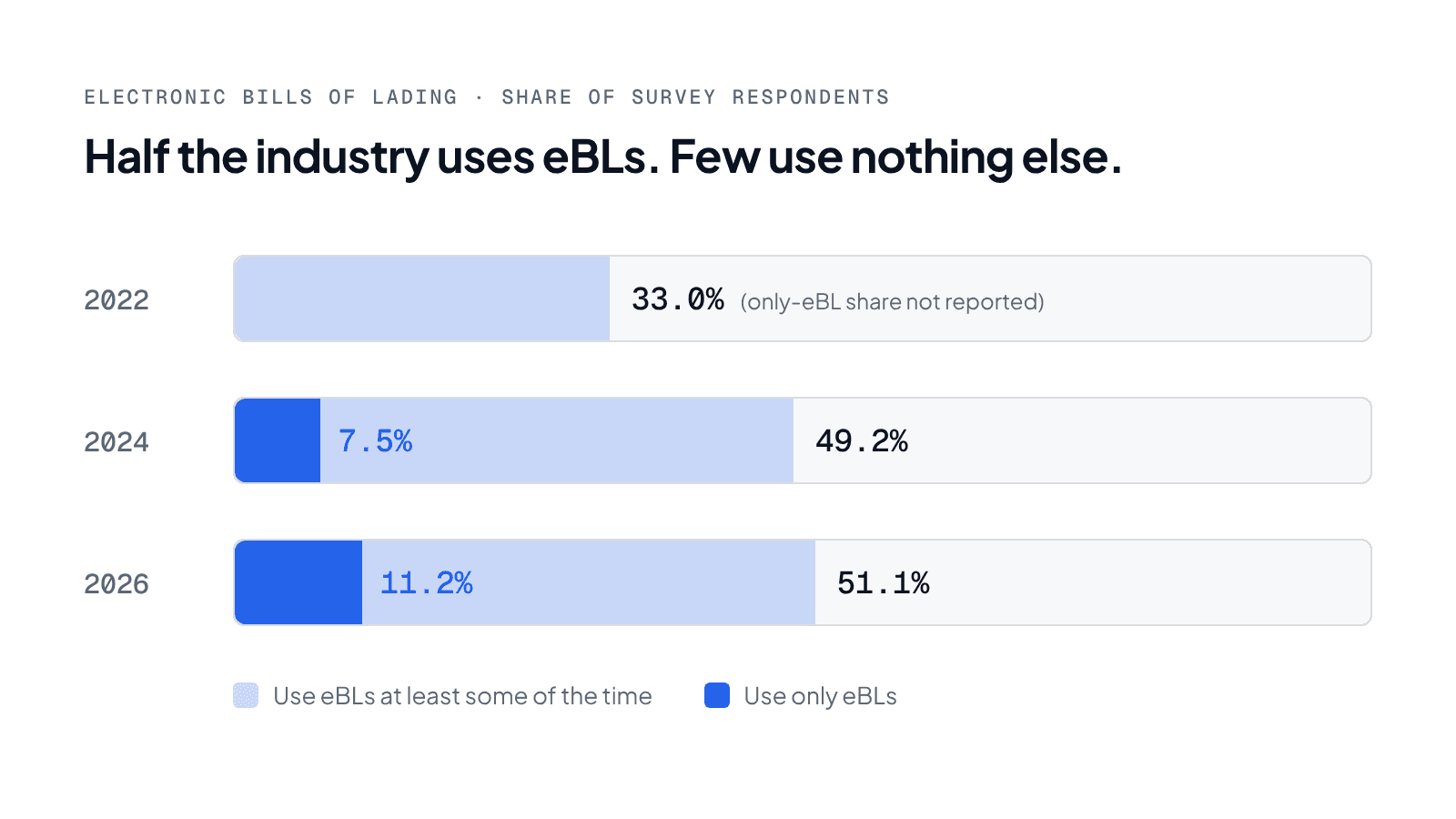
For most of the last decade, the electronic bill of lading was something carriers talked about at conferences. That has changed. On 21 October the FIT Alliance, a group set up by ICC, BIMCO, DCSA, FIATA and Swift, published its latest survey of the industry, and 51.1% of respondents now use eBLs at least some of the time, up from 33.0% in 2022.
The same survey shows how far there is to go. Only 11.2% use eBLs exclusively. Everyone else runs paper and electronic bills side by side, which is the hardest way to do it.
If you run a forwarding business with 20 or 50 people, the useful question is what this does to your desk over the next couple of years.
Carriers are moving first
The push is coming from the shipping lines. The member carriers of the Digital Container Shipping Association, which include most of the largest container lines, have committed to issuing 100% of their bills of lading electronically by 2030, with half to be electronic along the way.
For a forwarder, that means the master bill is the first document to change. Your bookings with the big lines will increasingly come back with an eBL issued on whichever platform that carrier has chosen, and you'll need an account on that platform to receive, endorse or surrender it.
House bills are slower to move, because you issue them. Nothing forces a change until your customers or their banks ask for one.
Forwarders now have their own electronic bill
In April, FIATA launched the electronic FIATA Multimodal Transport Bill of Lading (eFBL), a digital version of the negotiable FBL that many forwarders already issue on paper. It comes with a guide for forwarders covering onboarding, digital identity, liability insurance and how third parties can verify a bill.
That matters for independents. Until now, most eBL work has been built around the carriers. The eFBL gives a forwarder's own house bill a recognised electronic form, issued through FIATA's member associations, so a small firm isn't left choosing between a carrier's platform and paper.
The law depends on where you trade
Whether an electronic bill carries the same legal weight as paper depends on the country.
- United Kingdom. The Electronic Trade Documents Act 2023 has been in force since September 2023, so an eBL that meets its conditions is treated like the paper document.
- Singapore. Singapore adopted the UN model law on electronic transferable records (MLETR) in 2021.
- Australia. The Attorney-General's Department has consulted on implementing MLETR, but no law has passed yet. Australian forwarders still rely on the platform's contractual rules.
The survey suggests this is becoming less of a worry. The share of respondents who called legal acceptance a significant obstacle fell from 55.0% in 2022 to 42.6% in 2024. The concern people raised most this year was interoperability: an eBL issued on one platform often can't be passed to a party who uses another.
An eBL is only as good as the data typed into it
Here's the part that gets less attention. An electronic bill changes how the document travels. It doesn't change how the details get onto it.
At most small forwarders, the house bill is still typed from something else: the job sheet, the shipper's commercial invoice, an email with the booking. The consignee's name, the marks and numbers, the package count and the weights are typed into the job, then into the bill, then into the manifest and the invoice. Each time, there's a chance of a slip.
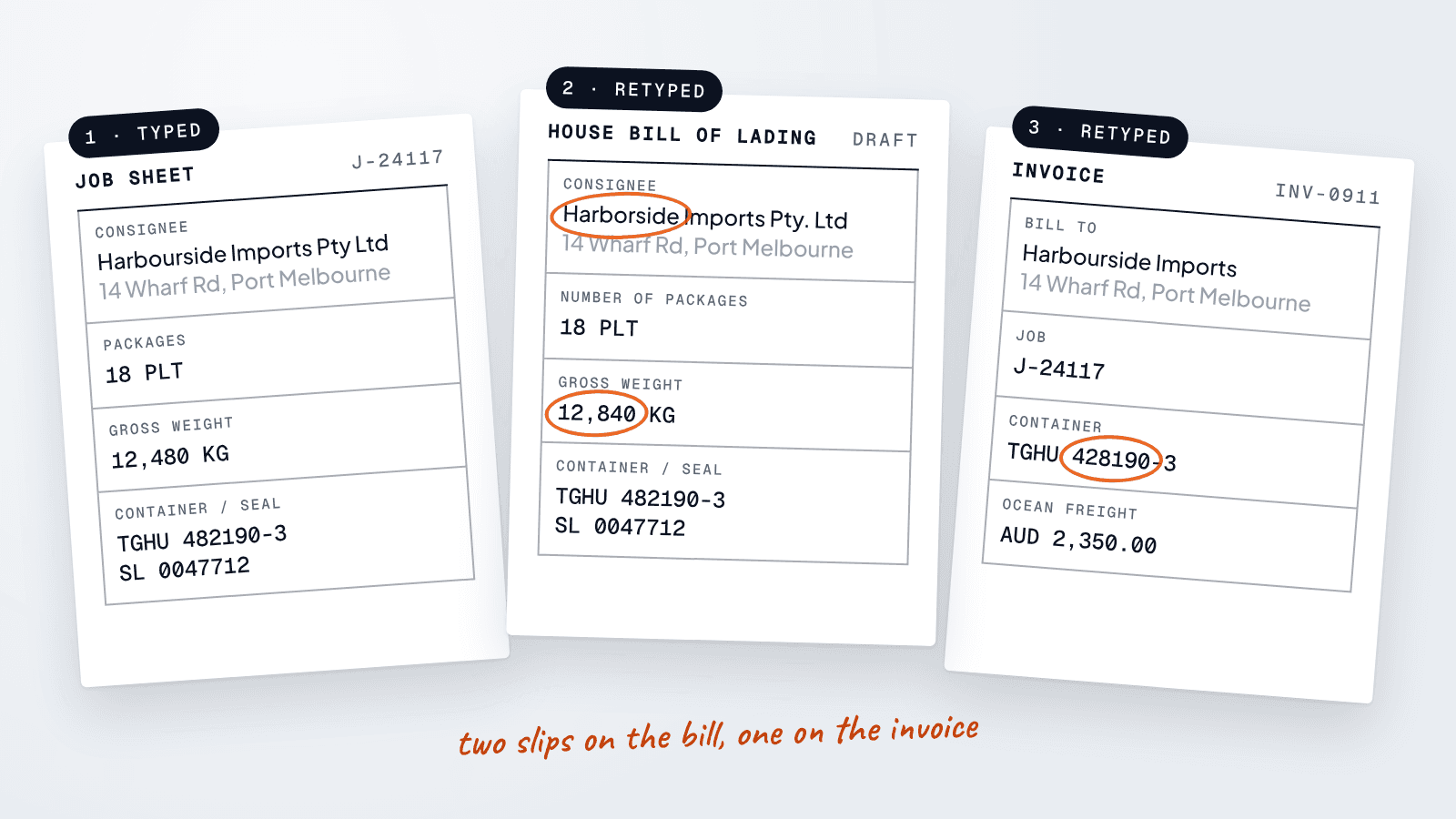
On paper, a typo means a corrected draft and another round with the shipper. On an eBL platform, an amendment after issue is a transaction on the platform, done under that platform's rules. If the bill has already been transferred, the correction has to go back through whoever holds it.
So the work that pays off first isn't picking a platform. It's getting the bill's data right before anyone issues anything.
What to do before your first eBL
None of this needs a big project. A few weeks of attention covers most of it.
- Count the retyping. Take ten recent jobs and note how many times the shipper, consignee, cargo description and weights were typed by hand. Three or four times is common.
- Find out who still needs paper. List the customers whose banks ask for original bills under a letter of credit. They'll be the last to move, and you'll run both systems for them.
- Ask your main carriers which platform they use. Most lines have picked one or two. Knowing which ones tells you which accounts you'll need.
- Talk to your national association about the eFBL. In the UK that's BIFA and in Australia the FTA. They'll know when it's available to members and what insurance it needs.
- Put the bill's data in one place. If the job record holds the parties, cargo lines, containers and seals, the bill, the manifest and the invoice can all be produced from it, and a correction only has to be made once.
Where CargoGen fits
CargoGen keeps each shipment in one job record. Its customized AI models read the commercial invoice and other documents into that job, a person checks the result, and the house bill, manifest and invoice are printed from the same data. When a detail changes, it's changed once on the job and every document picks it up.
That's the groundwork an electronic bill needs. Whichever platform your carriers and customers settle on, the details that go into it should come from one checked record.
See how a house bill is produced from one job record.
Bring a few of your own shipping documents to a demo and we'll show the job, the house bill and the invoice built from them.
Want to see the platform?
Field notes are nice, but live software is better. Book a demo and we'll run one of your own shipments through it.
Book a demo→